
The Reality
Another mile-marker has been passed, as it is now one short month before we leave Japan. The preparations for our departure, which had, up until now, been marked by leisurely procrastination, are rapidly cramming themselves into the forefront of our already crowded and slightly overwhelmed minds. My supervisor talked with me this morning about cutting off the utilities to our apartment, about final classes, goodbye parties, farewell speeches.
In so many ways, I'm ready to leave. At school I've been mentally-absent, distracted, anxious to get these last few lessons over and done with. I want to get home and get started on whatever comes next. But at the same time, I'm having the expected doubts. Why didn't we travel more in Asia? How could I have connected better with my students and co-workers? Would one more year have changed anything?
Monday, June 30, 2008

Wednesday, June 25, 2008
Hard Drives and Broken Teeth
Last week my hard drive crashed and I lost just about all the writing I'd done over the past two years. Meager scraps and lists of ideas, mostly, but it stings to know they're likely gone for good. Fortunately I had backed up my iPhoto library about a month ago, otherwise I would have lost upwards of 8,000 images from our past two years in Japan. I did, however, lose all my shots from our trips to Yamadera and Matsushima with Juli's brother Joe. Lessons learned, I'll be making monthly back-ups from now-on.
We spent Saturday through Tuesday in Tokyo, hunched under umbrellas with radii much too inadequate, sloshing through the crowds and arriving out-of-breath at out-of-the-way museums only to realize that yes, right, of course, they were closed at the particular moment we chose to visit them. This kind of defeated slogging is miserable enough, but it was aggravated by the triumphant return of my periodically dormant toothache, which seems to pound out its throbbing and grotesquely baroque rhythmns only when there are drastic changes in the barometric pressure. I downed four ibuprofen when the recommended dose was one, turned sleeplessly for two straight nights, and lubed up my molar with amounts of Amersol so generous that the entirety of my mouth went numb and Julianna complained that I smelled like a dentist's office.
Despite the elemental and oral setbacks, we had a good time showing Joe and his friend Seth around The Big Bento. I have a bit more to say about the trip, and the past two weeks, but it's very late, and I'm very tired, and so I'll wrap this up with a few random pictures from Tokyo:


Remember to check out my flickr page for more. www.flickr.com/photos/thewoodstove
Last week my hard drive crashed and I lost just about all the writing I'd done over the past two years. Meager scraps and lists of ideas, mostly, but it stings to know they're likely gone for good. Fortunately I had backed up my iPhoto library about a month ago, otherwise I would have lost upwards of 8,000 images from our past two years in Japan. I did, however, lose all my shots from our trips to Yamadera and Matsushima with Juli's brother Joe. Lessons learned, I'll be making monthly back-ups from now-on.
We spent Saturday through Tuesday in Tokyo, hunched under umbrellas with radii much too inadequate, sloshing through the crowds and arriving out-of-breath at out-of-the-way museums only to realize that yes, right, of course, they were closed at the particular moment we chose to visit them. This kind of defeated slogging is miserable enough, but it was aggravated by the triumphant return of my periodically dormant toothache, which seems to pound out its throbbing and grotesquely baroque rhythmns only when there are drastic changes in the barometric pressure. I downed four ibuprofen when the recommended dose was one, turned sleeplessly for two straight nights, and lubed up my molar with amounts of Amersol so generous that the entirety of my mouth went numb and Julianna complained that I smelled like a dentist's office.
Despite the elemental and oral setbacks, we had a good time showing Joe and his friend Seth around The Big Bento. I have a bit more to say about the trip, and the past two weeks, but it's very late, and I'm very tired, and so I'll wrap this up with a few random pictures from Tokyo:
Remember to check out my flickr page for more. www.flickr.com/photos/thewoodstove
Monday, June 16, 2008
Not the Big One
Two days ago Miyagi was hit by a magnitude 6-7 earthquake. Juli's brother Joe and his friend Seth are out visiting us, and when the quake hit we were sitting around the TV nurturing our nostalgia with a few clumsy rounds of Street Fighter II. The rolling started, I rushed to turn off the gas, and we all hung tight under our respective doorways. The shaking was largely side to side at first, but the quake ended with up-and-down shudders, the kind that topple buildings. It seemed to last for about 40 seconds or so.
When a quake hits, the fear I feel is never about the present moment, but about how bad the situation could possibly become. You never know how long it will last or how strong it will get.
The epicenter was in southern Iwate and the strongest area hit was a town in northern Miyagi called Kurihara. The scary thing is, that morning we were planning on going up to that area to visit our friend Aaron and go to an onsen. Had we gotten an early start, we probably would have been stuck in the middle of nowhere until the next day. All but one of the train lines out of Sendai were shut down for hours while inspectors scoured the tracks for damage. The train stations were all crowded with stranded passengers and the bus services were undoubtedly making a killing.
Things here return to normal pretty quickly after a quake, so while we couldn't make it out of town, we spent the day hotfooting it from place to place around Sendai. Yesterday the trains were running again, so we made it out to Yamadera, a mountainside temple/shrine complex that was built around AD 900.
While this quake was fairly large, Miyagi is anticipating the return of a massive off-shore earthquake that shakes things up about every 30 years. I hope we're long gong by the time that one hits.
Tuesday, June 10, 2008
The Weekend
On Saturday I (Casey) went to a high school kyudo tournament at the budokan in Nagamachi. Kyudo literally means "way of the bow," and in Japan, archery is considered not only as a sport, but also as an art and form of meditation. The venue was extremely crowded and there was no seating, so everyone simply bunched up against a guard rail. I managed to take some pictures after sneaking into the "matoba," the shed-like structure in which all the targets are nestled into a dirt hillock. This way I could see arrows up-close as they struck the targets.

Students collecting the arrows after they've been shot and scored:

This budding photographer had the best view of the day:

Then on Sunday Juli and I went hiking with a few friends through a gorge just outside of Sendai proper. We walked upstream for a few hours until we came to an overpass that spanned the gorge. This particular bridge is apparently one of Sendai's prime spots for suicides, and the area below is considered by the locals to be haunted. It was a bit creepy, standing there in the brisk water and looking up at the bridge about 100 feet above us. I found a junked tri-pod in the bushes and we all imagined the photographer trying to get one last shot in before he hit the shallow creek bed. Aside from the general spookiness, it was a beautiful hike and it was hard to imagine that the downtown part of Sendai was literally only a few minutes away. There were definitely a few parts where I imagined myself as a character on LOST, traipsing through the unexplored jungle.


On Monday we had a substitute holiday for having to "work" on Saturday (two hours at a kyudo tournament is hardly work), so we spent the whole day cleaning the apartment and getting suitcases packed to send home with Juli's brother, who is coming out to visit us later this week.
We're definitely in for a busy next few weeks. We'll go to Tokyo with Joe, show him around Miyagi, and after he leaves we'll only have five more weeks left in Japan!
On Saturday I (Casey) went to a high school kyudo tournament at the budokan in Nagamachi. Kyudo literally means "way of the bow," and in Japan, archery is considered not only as a sport, but also as an art and form of meditation. The venue was extremely crowded and there was no seating, so everyone simply bunched up against a guard rail. I managed to take some pictures after sneaking into the "matoba," the shed-like structure in which all the targets are nestled into a dirt hillock. This way I could see arrows up-close as they struck the targets.
Students collecting the arrows after they've been shot and scored:
This budding photographer had the best view of the day:
Then on Sunday Juli and I went hiking with a few friends through a gorge just outside of Sendai proper. We walked upstream for a few hours until we came to an overpass that spanned the gorge. This particular bridge is apparently one of Sendai's prime spots for suicides, and the area below is considered by the locals to be haunted. It was a bit creepy, standing there in the brisk water and looking up at the bridge about 100 feet above us. I found a junked tri-pod in the bushes and we all imagined the photographer trying to get one last shot in before he hit the shallow creek bed. Aside from the general spookiness, it was a beautiful hike and it was hard to imagine that the downtown part of Sendai was literally only a few minutes away. There were definitely a few parts where I imagined myself as a character on LOST, traipsing through the unexplored jungle.
On Monday we had a substitute holiday for having to "work" on Saturday (two hours at a kyudo tournament is hardly work), so we spent the whole day cleaning the apartment and getting suitcases packed to send home with Juli's brother, who is coming out to visit us later this week.
We're definitely in for a busy next few weeks. We'll go to Tokyo with Joe, show him around Miyagi, and after he leaves we'll only have five more weeks left in Japan!
Monday, May 19, 2008
One Hundred Posts (in Solitude)
Here it is, our one hundredth post! Seems kind of pitiable, actually, only one hundred posts in two years, but then again there have been vast stretches of time in which Juli and I have lain catatonic in our cryogenic sleep chambers, with little or nothing to report and lacking the mental wherewithal to report it. Our date for leaving Japan is drawing nigh, so hopefully you've notice that we've rubbed the sleepers from our eyes, stretched our atrophied writing digits, and tried to sum up our daily mundanities with a more pulsar-like regularity.
This weekend was Aoba matsuri (festival), a celebration of Sendai's Aoba-ward, which happens to be the part of town in which we live. Aoba matsuri commemorates the construction of the Toshu-gu shrine, which was completed in 1654. Large floats, called yamaboko are wheeled down Jozenji street, and troupes of dancers perform suzume odori, a traditional jig supposedly improvised by drunken stone-masons upon the completion of Sendai castle, which imitates the fluttering motions of tree swallows (can't make that up). The dance is accompanied by tin whistles, banged pots, and taiko drums playing a distinctive, repetitive refrain.
Juli went up to Kogota Friday night to visit Dan and Andy, and got a crash course in parenting courtesy of Kai, their three month old baby. Apparently, Juli says, the best way to quiet a crying tot is to hold a mirror above his face, rub his tummy, and tell him how handsome he is. Would work for me too, I guess.
The highlight of the weekend was definitely dinner on Saturday night. A month ago, our friends Kyo and Jen told us about this Japanese woman who runs a restaurant out of her apartment. Calling it a restaurant is a bit inaccurate though, as it's only open on weekends and can seat a maximum of five people. The experience is more like going to someone's home, having them fix you an amazing dinner, and then paying them for it. And it was amazing. The woman, whose name I can't recall at the moment, takes regular trips to Italy, where she takes cooking clases. To supplement her income, she makes home-cooked meals for anyone willing to make a reservation. We had a delicious six-course dinner while her tiny dog Gu-chan napped on the nearby couch.
Sunday was a bit lazy. We went into town to watch part of the parade, had lunch with our friend Makiyo, and then I went home to photoshop some images and play copious amounts of online Mario Kart.
Next weekend we're going hiking up to Yamadera, a famous mountain-side temple complex, with some of my school's English teachers.
Wednesday, May 14, 2008
Hachiman, Little Big Neighborhood
A few days ago I went walking, looking for the highest vantage point from which to photograph Hachiman, our neighborhood. I found a run-down, on-the-verge-of-being-condemned apartment building and scaled its seven story iron fire escape, trying not to imagine how it would pitch and sway during an earthquake like the modestly big one we had last week. At the top I took a few photos and a little school girl, probably seven or eight, came blasting out of her apartment, saw me standing oafishly by the ledge, and came to a dead, silent stop. I turned around to smile and she slunk away toward the elevator. Oh well.
Here are the photos. I've been playing around with making fake tilt-shift images lately, a process that skews perspective in such a way that the resulting photographs look like miniature model train sets. Let me know what you think.


Click on any of the images to go to my flickr site, where you can view full-size versions of the images. Thanks!
A few days ago I went walking, looking for the highest vantage point from which to photograph Hachiman, our neighborhood. I found a run-down, on-the-verge-of-being-condemned apartment building and scaled its seven story iron fire escape, trying not to imagine how it would pitch and sway during an earthquake like the modestly big one we had last week. At the top I took a few photos and a little school girl, probably seven or eight, came blasting out of her apartment, saw me standing oafishly by the ledge, and came to a dead, silent stop. I turned around to smile and she slunk away toward the elevator. Oh well.
Here are the photos. I've been playing around with making fake tilt-shift images lately, a process that skews perspective in such a way that the resulting photographs look like miniature model train sets. Let me know what you think.
Click on any of the images to go to my flickr site, where you can view full-size versions of the images. Thanks!
Tuesday, May 13, 2008
Reverse Culture Shock
I'm going to go on the record here and make a few predictions about what I'll be thinking when Julianna and I come home from Japan in August.
"No one is staring at me."
Imagine, for a moment, that you are waiting for a bus. Across the street a Hitler impersonator in drag is tying balloon animals for an imaginary crowd of no one. Imagine a man with backwards-jointed faun knees doing backflips outside the post office. Imagine, then, the rubbernecking pandemonium of Amazonian nudist beauties lining vast stretches of America's highways in protest of the Iraq war. In Japan, I illicit more stares than all three. I have provoked deep gasps of amazement and impromptu height comparisons with complete strangers. In a way, I will miss being perceived as different. However, the "otherness" of my appearance has also led to wary stares, never more apparent than when I'm taking public transportation. "The Stare" is an unavoidable feature of life in Japan for a foreigner, and I have a feeling I'll either love the slinking anonymity of being back among blond-fronded giants, or I'll have a mild identity crisis over not being noticed. It's like Naomi Watts in I Heart Huckabees: "Stop looking at me. Don't look at me. No, look at me. Please everybody look at me!"
"Everyone is red and fat and poorly dressed.
I have to hand it to the Japanese for being slim, trim, and generally sharp-looking people. In America, the girl out shopping in her paw-print-on-the-ass sweat pants is a virtual pandemic. Transported to Japan, her laissez faire fashion sense would be brutally and deservedly dismantled.
"I just spoke in Japanese to the waitress."
This happened already, actually, when Juli and I were home for Christmas. Straight off the plane my parents took us to The Olive Garden, where I bumped into a waitress and repeatedly mumbled "sumimasen" (I'm sorry) while making mini self-depreciating head bows. For a few months I'll probably make a gutteral "uhnn" when I mean "yes," and please don't stare at me if I bob my head like a disconcerted bird when I'm talking on the phone.
Monday, May 12, 2008
Golden Week
Golden Week is Japan's equivalent of Spring Brink, but with marginally less booze. Certainly no breasts are being shown, anyhow. Rather, the week is golden because it contains three national holidays. This year, two of those holidays fell on Saturday and Sunday, which cut Golden Week unceremoniously short and demoted it, as my friend Ewan said, to "Bronze Week." Still, we tried to make the best of it.
Kaori, one of our Japanese friends we knew in Seattle, decided to come up to Sendai and spend the weekend with us. We had a long standing invitation to stay at our friend Aaron's place, so the three of us, like Basho himself, made our way into Miyagi's deep northern interior. Aaron's place is in a small town, and unlike most apartment-bound JETs, he lives by himself in a self-standing, cottage-like house. Like any good Portlander worth his salt, Aaron is a great outdoorsman, and so he took us around to some of his favorite natural haunts, including a swimming hole where we found fossilized leaves (see below), and a short hike up to a fairly magnificent waterfall. After the hiking we had lunch at a great family-owned roadside restaurant/produce market, where we saw a grandmother kill a giant Asian hornet, the size of her fist, with a tiny fly swatter. Our hunger satiated, Aaron took us to Naruko, a small town famous for its onsen resorts. The best onsen are natural outdoor hotsprings, and the one we went to was beautiful. It overlooked a river and the blossoms from an adjacent cherry tree drifted down upon us while we were bathing. That night, after a big meal, I played guitar with Aaron and Kaori joined in on a bunch of Belle and Sebastian songs.


Then, on Tuesday, we met up with Joy and Sergio and went to the Yagiyama zoo, which is near my visit school. It's a small zoo, and most of the animals looked depressed, except for the monkeys, who were very clearly bi-polar. Still, we had a good time and Juli was seconds away from hopping the fence into the tiger cage when he started purring his throaty tiger purr.

Golden Week is Japan's equivalent of Spring Brink, but with marginally less booze. Certainly no breasts are being shown, anyhow. Rather, the week is golden because it contains three national holidays. This year, two of those holidays fell on Saturday and Sunday, which cut Golden Week unceremoniously short and demoted it, as my friend Ewan said, to "Bronze Week." Still, we tried to make the best of it.
Kaori, one of our Japanese friends we knew in Seattle, decided to come up to Sendai and spend the weekend with us. We had a long standing invitation to stay at our friend Aaron's place, so the three of us, like Basho himself, made our way into Miyagi's deep northern interior. Aaron's place is in a small town, and unlike most apartment-bound JETs, he lives by himself in a self-standing, cottage-like house. Like any good Portlander worth his salt, Aaron is a great outdoorsman, and so he took us around to some of his favorite natural haunts, including a swimming hole where we found fossilized leaves (see below), and a short hike up to a fairly magnificent waterfall. After the hiking we had lunch at a great family-owned roadside restaurant/produce market, where we saw a grandmother kill a giant Asian hornet, the size of her fist, with a tiny fly swatter. Our hunger satiated, Aaron took us to Naruko, a small town famous for its onsen resorts. The best onsen are natural outdoor hotsprings, and the one we went to was beautiful. It overlooked a river and the blossoms from an adjacent cherry tree drifted down upon us while we were bathing. That night, after a big meal, I played guitar with Aaron and Kaori joined in on a bunch of Belle and Sebastian songs.
Then, on Tuesday, we met up with Joy and Sergio and went to the Yagiyama zoo, which is near my visit school. It's a small zoo, and most of the animals looked depressed, except for the monkeys, who were very clearly bi-polar. Still, we had a good time and Juli was seconds away from hopping the fence into the tiger cage when he started purring his throaty tiger purr.
Thursday, May 08, 2008
Two From the Archives
Last year, a few of us when up to see the "snow monsters," trees encased in ice, at Mt. Zao. This is me trying, unsuccessfully, to hop from one tree to the other.
April is campaign season in Japan, and last year we lived directly above a local candidate's campaign office. His stump speeches often woke us up on Saturday mornings.
Tuesday, May 06, 2008
Thursday, May 01, 2008
Park Golf
On Tuesday, a bunch of us ventured north to the tiny town of Tajiri to engage in the fierce geriatric sport of "Park Golf," a three way hybrid of mini-golf, real golf, and croquet. Park golf was invented in Hokkaido in 1983, and while I don't claim to know the history of the sport, I assume the shrunken size of the courses has something to do with the high cost and unavailability of land in Japan. A park golf course is composed of nine holes and must not exceed 500 meters in total length. Standard golf rules apply, but "parkers," as they are known, are limited to one ball and one extremely short (for me) club.
With the exception of one or two families with children, we were the sole representatives of the "under 65" crowd. Old ladies with question mark postures hunched over the tees and thwacked away while their bespectacled husbands reviewed anxiously their scorecard's every chickenscratched number. Attire was thoroughly professional and accessorized to the nines with shoe-bound ball carriers and laminated scorecard protectors. Floppy hats were in abundance.
Not to be outdone by a bunch of toothless retirees, we came decked out in all manner of golf fashion. Pant cuffs were rolled, socks were hitched, and I made damn sure to doff my cap any chance I got. The old folks looked on with bemused curiosity, the men snapping their gums, the little women prim, their cotton candy hair bobbing in the late spring breeze.
A Recent Acquisition
Last week I (Casey) bought a used Mamiya RZ67 from a small camera shop here in Sendai. A staple in fashion photography (though quickly being supplanted by digital), the RZ67 is a 6x7 medium format camera with a rotating back, which allows you to shoot in landscape or portrait orientations without moving the camera body. It's a modular system, so the lenses, viewfinders, and film backs are all interchangeable. At around 7lbs it's a beast to carry around, but I managed to handhold it all day Saturday while my school was having its annual sports festival.

Last week I (Casey) bought a used Mamiya RZ67 from a small camera shop here in Sendai. A staple in fashion photography (though quickly being supplanted by digital), the RZ67 is a 6x7 medium format camera with a rotating back, which allows you to shoot in landscape or portrait orientations without moving the camera body. It's a modular system, so the lenses, viewfinders, and film backs are all interchangeable. At around 7lbs it's a beast to carry around, but I managed to handhold it all day Saturday while my school was having its annual sports festival.
Sunday, April 27, 2008

Wednesday, April 23, 2008
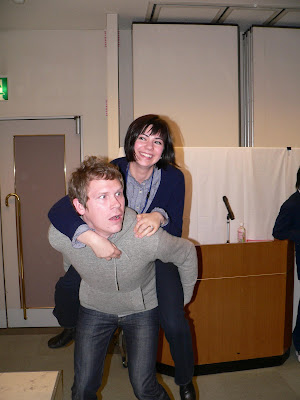
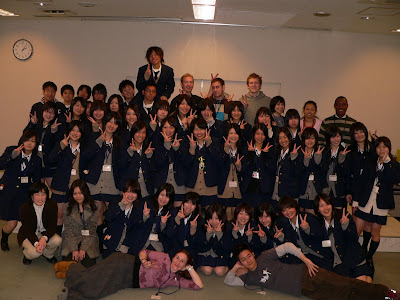
Casey and I were invited to participate in the annual Izumi English Camp. I was in charge of teaching Gospel music, Arabic script, belly dancing and being generally responsible for a team of shy girls named "SESAM5." Casey taught Patois and reggae music while simulatenously being responsible for a group of impious girls who chose to go by "JACKO." We bathed in the onsens, chased kids down the halls, and ate more ice cream than you could shake a waffle cone at.




Monday, April 21, 2008
Agfa Isolette II
I picked up this little gem on our last trip to Tokyo. It's a German, medium-format folding camera that was produced between 1950 and 1958. Because of the folding bellows design, it's incredibly portable, even if it has the density of a sturdy but slightly overweight German matron.


I've been wanting to dive into medium-format photography for awhile (I don't think lomo-style Holga stuff counts, really), and I've got my eyes out for the following:
-Rolleiflex 2.8f
-Hasselblad 500 c/m
-Mamiya C330
The used camera market in Japan is amazing, as would be expected, but it suffers from price-inflation of cameras that are considered "classic." A Rolleiflex in decent condition in the states would run between $500 and $1000, while here Japan they go for upwards of 200000 yen (about $2000). While it's undoubtedly a "collector's" camera, it's a shame to see such a beautiful tool be put on a shelf or in a moisture-free safe, never to be used. Japanese-made cameras fare better. Mamiya systems can be found for a good deal cheaper, and used Nikon and Canon lenses are overabundant. New gear skews higher in price, oddly enough, compared to the states. I've been looking at getting a SB-800 speedlight for my D80, but they cost almost $500 here, whereas in the US you can find them for $300. The discrepancy seems ridiculous considering that there's a Nikon factory here in Sendai, but I suppose the hobbyists here are simply used to getting price gouged. I've got to give it to the Japanese for being the best-equipped amateur photographers in the world. When we visited Kyoto I saw flocks of the elderly carrying massive Manfrotto tripods and pro camera bodies slung around their necks like dead albatross.
I picked up this little gem on our last trip to Tokyo. It's a German, medium-format folding camera that was produced between 1950 and 1958. Because of the folding bellows design, it's incredibly portable, even if it has the density of a sturdy but slightly overweight German matron.
I've been wanting to dive into medium-format photography for awhile (I don't think lomo-style Holga stuff counts, really), and I've got my eyes out for the following:
-Rolleiflex 2.8f
-Hasselblad 500 c/m
-Mamiya C330
The used camera market in Japan is amazing, as would be expected, but it suffers from price-inflation of cameras that are considered "classic." A Rolleiflex in decent condition in the states would run between $500 and $1000, while here Japan they go for upwards of 200000 yen (about $2000). While it's undoubtedly a "collector's" camera, it's a shame to see such a beautiful tool be put on a shelf or in a moisture-free safe, never to be used. Japanese-made cameras fare better. Mamiya systems can be found for a good deal cheaper, and used Nikon and Canon lenses are overabundant. New gear skews higher in price, oddly enough, compared to the states. I've been looking at getting a SB-800 speedlight for my D80, but they cost almost $500 here, whereas in the US you can find them for $300. The discrepancy seems ridiculous considering that there's a Nikon factory here in Sendai, but I suppose the hobbyists here are simply used to getting price gouged. I've got to give it to the Japanese for being the best-equipped amateur photographers in the world. When we visited Kyoto I saw flocks of the elderly carrying massive Manfrotto tripods and pro camera bodies slung around their necks like dead albatross.
Friday, April 18, 2008
It is Hanami season, Japan's favorite time of the year. Which means you hang out under the cherry blossom trees with your friends to celebrate the arrival of spring by drinking sake until you're too inebriated to point straight.
We hanami-ed it up in Shiroishi, a thirty minute train ride south, home of the famous Shiroishi castle and annual winter home for Siberia's migrating swans. Below is Maria "ants-in-her-pants" Filippone and I giddy off the blossoms, and hamming it up for Casey.


We hanami-ed it up in Shiroishi, a thirty minute train ride south, home of the famous Shiroishi castle and annual winter home for Siberia's migrating swans. Below is Maria "ants-in-her-pants" Filippone and I giddy off the blossoms, and hamming it up for Casey.


Monday, April 07, 2008
Two weeks ago, the JETs in Miyagi put on a pantomime. Casey took pictures and helped write the skit, while I and Amy Crossley did the makeup. The best part was that I got to transform the very American and male Jesse into the Sadoko, the archetypal vengeful Japanese female ghost made famous in The Ring. He looked more like a panda bear in the begining, but things came together in the end.


Thursday, April 03, 2008
Sakura, Sakura
Within a week, the cherry blossoms will bloom and initiate Japan’s sacred rites of spring. Old semi-toothed men will congregate on blue plastic tarps in the shade and tipple long draughts from tallboy cans of Asahi Super-Dry. The weaker, or perhaps more wistful among them will lay supine and let the falling blossoms turn them into pink old man cupcakes. The others will rub their noses, grimacing into the sun, and think between sips of how not to think about what it really means when cherry blossoms fall.
All around, families will crowd under the trees, their shoes removed and carefully twinned along the perimeters of their tarpaulins. They will eat from bento boxes, get cramps in their legs, and feel natsukashi*. Wind will pass though the trees and carry off chopstick wrappers and plastic packaging. The more concerned citizens will hurriedly slip their shoes back on and chase down the errant bits of wind-borne garbage, making sure to deposit them in the proper receptacles.
Naturally, there will be festival goods for sale. Tanned vendors with wizened faces will hawk plastic superhero masks and overpriced candy. Rows of canvas booths will offer yakisoba and grilled corn, chicken skewers and fried balls of battered octopus. There will be long queues and the cashiers will holler at the cooks to hurry it up. But off in a corner, the Chinese man selling beer and lime "margaritas" with his small son will not get much business. They will sit on plastic stools and the man will wonder why he is doing this again. He will think, over the hours, about fishing, about his son, and about his very beautiful wife, who is somewhere else. When I approach he will stand up and motion for his boy to take my order. I will show one finger, hand the boy 500 yen and smile as his father salts the rim of my plastic cup. When he hands me the beer I will say thank you in English and he will grin and nod and wipe his hands on his apron before sitting down again.
*nostalgia or fondness
Subscribe to:
Posts (Atom)
